How to Plan a Tattoo Sleeve Near Burlington, NJ
A sleeve is the most ambitious tattoo project most people will ever take on. Here is how to plan it correctly - from the initial concept to the final session - so the finished result is something you'll be proud of for decades.
What Is a Tattoo Sleeve?
A tattoo sleeve is a collection of tattoos that covers all or most of an arm - from shoulder to wrist for a full sleeve, shoulder to elbow for a half sleeve, or elbow to wrist for a quarter sleeve. Sleeves can be a single cohesive composition planned from the start, or a collection of individual pieces that are connected over time.
Either approach can produce excellent results, but the planned approach - where the entire sleeve is designed as a unified composition before any individual pieces are executed - tends to produce more visually cohesive results. It also avoids the common problem of having a collection of disconnected pieces that do not work together as a whole.
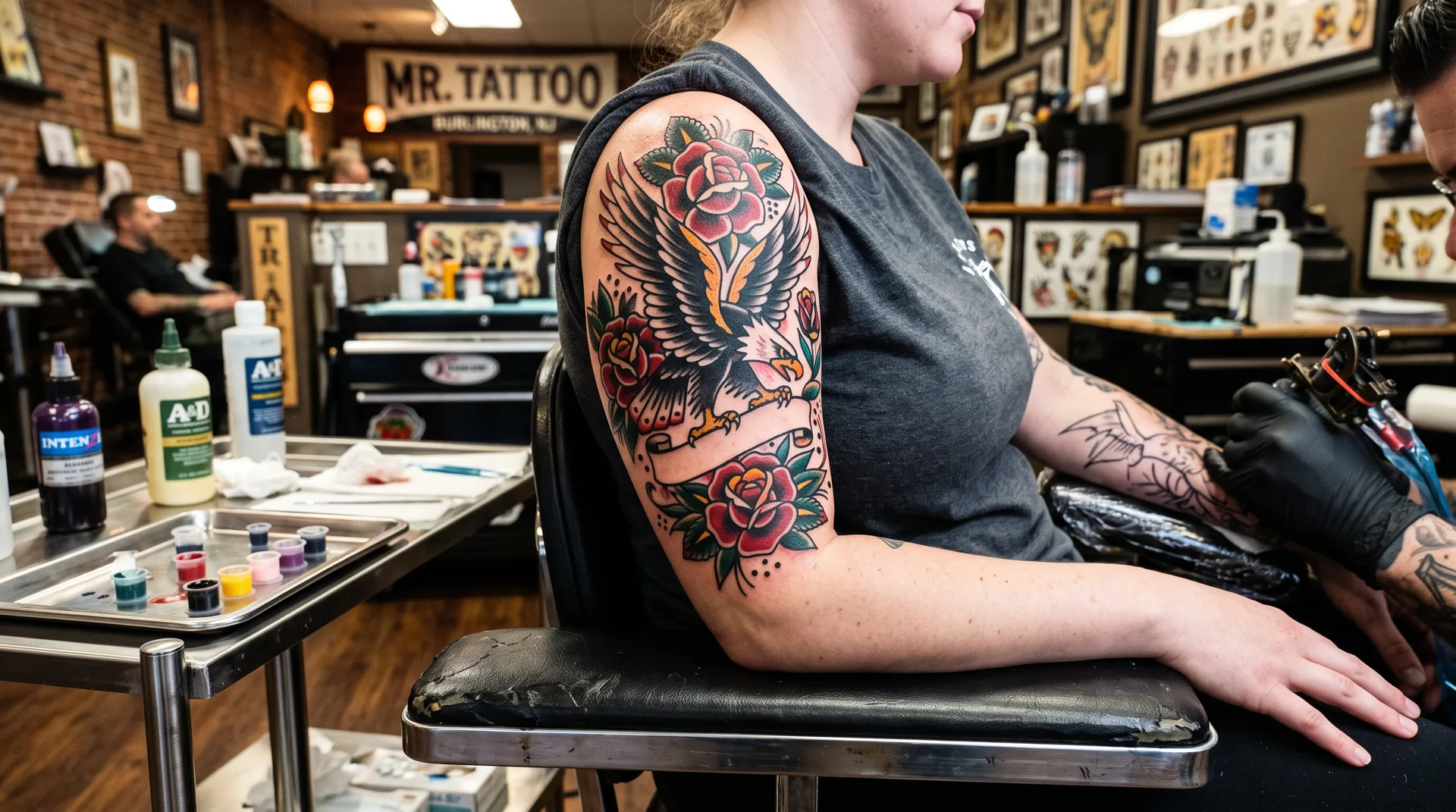
The artists at Mr. Tattoo in Burlington, NJ have extensive experience with sleeve work. The gallery includes examples of sleeve projects in multiple styles.
Step 1 - Choose a Style Before You Choose Subjects
The most common mistake people make when planning a sleeve is focusing on subjects before deciding on a style. A sleeve that mixes Japanese koi with American traditional eagles and black and grey realism portraits will look chaotic and disjointed regardless of how good each individual piece is.
Choosing a consistent style - or a deliberate blend of compatible styles - is the foundation of a cohesive sleeve. The most popular styles for sleeves are:
- Japanese traditional (Irezumi) - The most sleeve-oriented style in existence. The compositions are designed to flow with the arm and the subject matter - koi, dragons, tigers, waves - lends itself naturally to large-scale work.
- American traditional - Bold, graphic, and extremely durable. Traditional sleeves age better than almost any other style.
- Black and grey realism - Portrait-heavy sleeves, often memorial or biographical in nature. Requires an artist with strong realism skills.
- Neo-traditional - A bridge between traditional and realism that allows for more complex subject matter while maintaining structural integrity.
Read the full breakdown of tattoo styles available near Burlington, NJ to understand the trade-offs of each before committing.
Step 2 - Plan the Composition
A sleeve is a composition that wraps around a three-dimensional surface. Unlike a flat canvas, the arm has curves, muscle groups, and natural contours that affect how the design reads from different angles. A good sleeve design accounts for all of this.
Key compositional decisions include:
- Focal points - Where are the main subjects placed? The outer forearm and upper arm are the most visible areas and typically receive the primary subjects.
- Flow - How does the eye move through the composition? Japanese sleeves traditionally use waves, wind bars, and background elements to create movement and connect individual subjects.
- Background - What fills the space between subjects? Background elements are what transform a collection of individual tattoos into a cohesive sleeve.
- Ditch and inner arm - The ditch (inside of the elbow) and inner arm are more sensitive and tend to fade faster. Designs in these areas need to account for this.
Step 3 - Budget and Session Planning
A full sleeve is a significant financial commitment. Depending on the complexity, style, and number of sessions required, a full sleeve can take anywhere from 20 to 60+ hours of work spread across multiple sessions over months or years.
Session planning matters as much as the design itself. Large areas of the sleeve are typically done in stages - outline first, then shading, then color - with healing time between each stage. Trying to rush through too much in a single session produces worse results and is harder on the body.
During your consultation at Mr. Tattoo, the artist will give you a realistic breakdown of the session structure, time commitment, and pricing for your specific project before you commit to anything.
Working Around Existing Tattoos
Many people start a sleeve by incorporating existing tattoos. This can work very well or create significant limitations depending on the style and placement of the existing work.
Existing tattoos that are stylistically compatible with the planned sleeve can often be incorporated directly into the composition. Existing tattoos that are stylistically inconsistent may need to be covered or reworked. Read the complete guide to tattoo cover-ups if this applies to your situation.
The artists at Mr. Tattoo - including Jason, Dave Mek Klama, and Gaige - each bring different strengths to sleeve work. The consultation process will help you identify which artist is the best fit for your specific project.
Starting a Sleeve Near Burlington County and Camden County, NJ
Mr. Tattoo is located at 673 High St in Burlington City. Clients come from across the region for large-scale work - from Cherry Hill and Voorhees in Camden County to Moorestown, Mount Laurel, Marlton, and Evesham in Burlington County.
A sleeve starts with a conversation. Book a consultation and bring your references, your existing work (if applicable), and your ideas. The artists will help you build a plan that makes sense for your concept, your timeline, and your budget.
Serving Burlington & Camden County
Burlington, NJ - 673 High St
Ready to Start Your Sleeve?
Book a consultation and bring your ideas. The artists at Mr. Tattoo will help you build a plan that works.