The Best Tattoo Styles Available Near Burlington, NJ
From bold Japanese sleeves to ultra-thin fine line work - here is a breakdown of the most popular tattoo styles, what makes each one distinct, and which artists near Burlington County, NJ specialize in each.
Why Tattoo Style Matters Before You Book
Most people come in with a concept - a wolf, a rose, a memorial portrait - but the style that concept gets executed in determines everything about how it ages, how it reads on your skin, and whether it will still look sharp in 15 years. Two artists can tattoo the same subject and produce completely different results based on style alone.
At Mr. Tattoo in Burlington, NJ, the artists work across a wide range of styles. Understanding which style fits your idea is the first real step in the process. Here is a breakdown of the most in-demand styles and what each one actually involves.
1. Japanese Traditional (Irezumi)
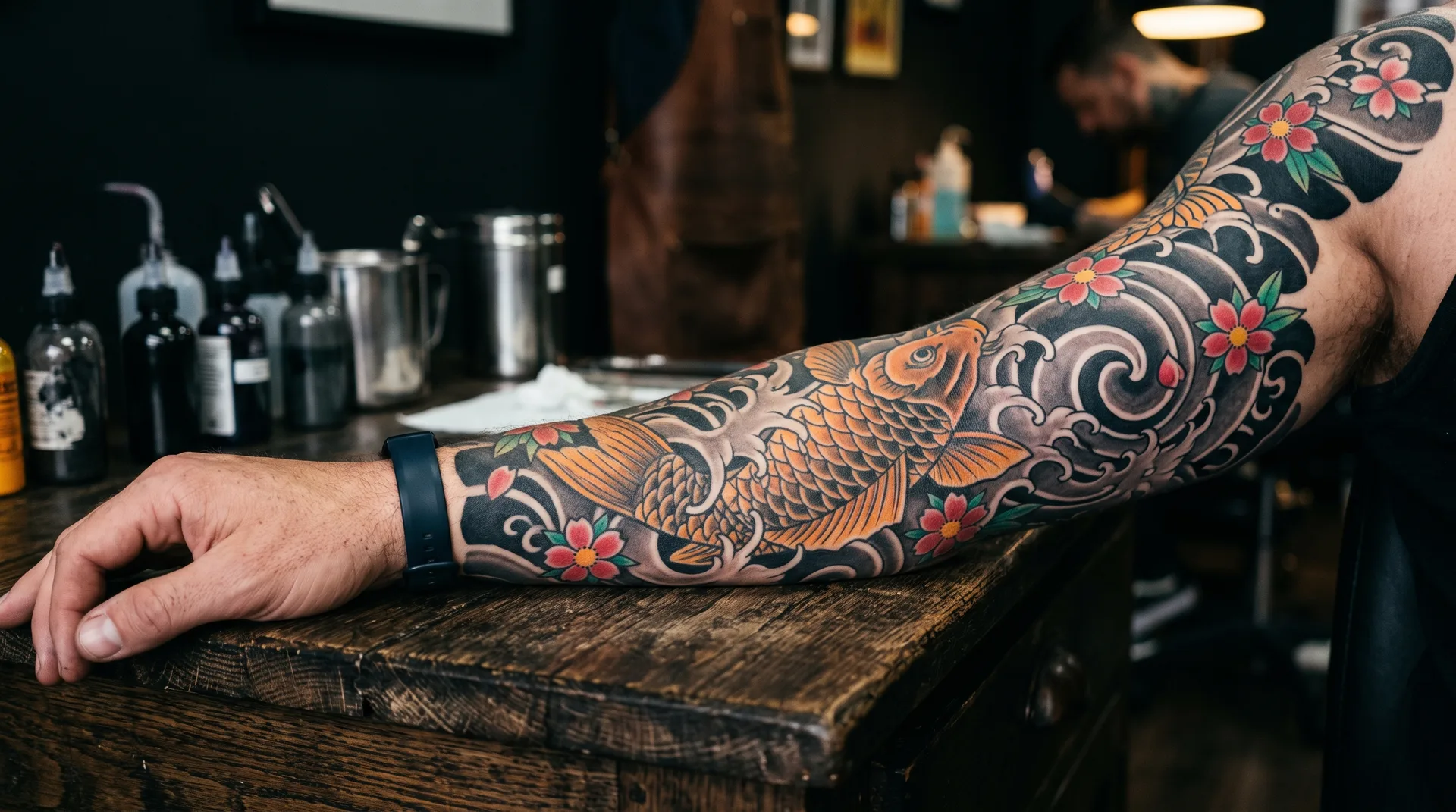
Japanese tattooing is one of the oldest and most technically demanding styles in the world. The hallmarks are bold outlines, saturated color fills, and iconic subject matter - koi fish, dragons, tigers, peonies, waves, and cherry blossoms. The compositions are designed to flow with the body, which is why Japanese work looks so natural on sleeves, back pieces, and full-body suits.
What makes Japanese tattooing hold up so well over time is the structure. The bold black outlines lock the color in place. The large fields of saturated color age better than fine detail because there is more ink per square inch. A well-executed Japanese sleeve done at 25 will still read clearly at 55.
If you are considering a Japanese piece, the artists at Mr. Tattoo can walk you through composition options for your specific placement before anything is committed to skin.
2. Black and Grey Realism
Black and grey realism is exactly what it sounds like - photorealistic imagery rendered entirely in black ink and grey washes. Portraits, animals, landscapes, and memorial pieces are the most common subjects. The technique requires a thorough understanding of light, shadow, and value - skills that take years to develop.
The difference between a good black and grey piece and a great one comes down to the range of tonal values the artist can achieve. Flat grey with no depth looks amateur. Proper black and grey realism has deep blacks, clean whites, and a smooth gradient between them that creates the illusion of three-dimensional form.
You can see examples of this work in the gallery and in the individual artist portfolios. Jason's portfolio and Dave Mek Klama's portfolio both include strong examples of black and grey work.
3. American Traditional
American traditional is the foundation of Western tattooing. Bold black outlines, a limited color palette (red, green, yellow, black), and iconic imagery - eagles, anchors, daggers, roses, pin-ups, and panthers. The style is intentionally graphic and flat, which is why it ages better than almost any other style. There is no fine detail to blur out over time.
Traditional work is also one of the most forgiving styles for placement. It reads well on arms, legs, chests, and backs. If you want something that will look as good in 30 years as it does the day it heals, traditional is one of the safest bets you can make.
If you're near Cherry Hill, Moorestown, or Mount Laurel and looking for traditional work, the drive to Burlington City is worth it for the quality of execution at Mr. Tattoo.
4. Fine Line and Single Needle
Fine line tattooing uses a single needle or very tight groupings to create thin, delicate lines with minimal shading. The results can be incredibly detailed and elegant - botanical illustrations, geometric patterns, handwriting, small portraits. The style has exploded in popularity over the past decade.
The honest caveat with fine line work is aging. Thin lines spread over time as the ink settles into the skin. A fine line tattoo that looks razor-sharp at healing will look softer at 10 years. This is not a flaw - it is physics. A skilled artist will design fine line work with this in mind, using appropriate spacing and line weight so the piece still reads well as it ages.
Placement matters more with fine line than with almost any other style. High-friction areas like hands, wrists, and feet will cause fine line work to fade faster. An honest conversation with the artist before you book - which is exactly what a tattoo consultation is for - will set realistic expectations.
5. Neo-Traditional
Neo-traditional takes the bold outlines and structured composition of American traditional and expands the color palette, adds more detail, and allows for more complex subject matter. Animals, portraits, fantasy imagery, and elaborate floral designs are common. The style sits between traditional and realism - more graphic than pure realism, more detailed than classic traditional.
Neo-traditional work tends to age well because it retains the structural foundation of traditional tattooing - strong outlines that hold the design together - while incorporating the visual richness of more contemporary styles.
6. Geometric and Dotwork
Geometric tattooing uses precise lines, shapes, and patterns to create structured, mathematical compositions. Dotwork is a related technique that builds shading and form through patterns of dots rather than solid fills. Both styles are popular for mandalas, sacred geometry, and abstract compositions.
The technical demand of geometric work is in the precision. A line that is slightly off, a circle that is not quite round - these errors are obvious in geometric work in a way they would not be in a more organic style. The artists at Mr. Tattoo have the technical foundation to execute geometric work correctly.
7. Watercolor
Watercolor tattoos mimic the look of watercolor paintings - loose, flowing color with soft edges and no hard outlines. The style can be visually stunning. The trade-off is longevity. Without the structural anchor of bold outlines, watercolor tattoos tend to fade and lose definition faster than other styles.
A skilled artist can mitigate this by building a stronger underlying structure and using the watercolor effect as an accent rather than the sole design element. If you're drawn to the watercolor aesthetic, an honest consultation about what to expect long-term is essential.
Which Style Is Right for You?
The right style depends on three things: your concept, your placement, and how you want it to age. A portrait on a forearm calls for different technical decisions than a floral piece on a shoulder blade. A style that looks incredible on Instagram might not be the best choice for your specific skin tone, body placement, or long-term goals.
The best way to figure this out is to have a real conversation with an artist. Book a consultation at Mr. Tattoo in Burlington City and bring your references. The artists will tell you honestly which style will serve your idea best and what to expect from each option.
Mr. Tattoo is located at 673 High St in Burlington City, serving clients from across Burlington County and Camden County. Walk-ins are welcome Monday through Saturday, 12pm to 8pm.
Serving Burlington & Camden County
Burlington, NJ - 673 High St
Ready to Talk Through Your Style?
Come in, send a message, or book a consultation. Mr. Tattoo is open Monday through Saturday, 12pm to 8pm at 673 High St in Burlington City.